

The Bing Search API has ended forever on August 11, 2025, and many developers were forced to look for alternative search API overnight. In case you are looking for a good search API company homepage to use for your next API integration project, you are familiar with this problem – all vendor websites look good, all headlines claim “enterprise-grade reliability,” but none of them tells what you need.
Fortunately, this guide helps you to navigate this problem. Here you will find out about different types of search API, changes in the market in 2026 and how to analyze vendor homepages as an experienced developer. So, start with the decision most developers skip: figuring out which type of search API you actually need.
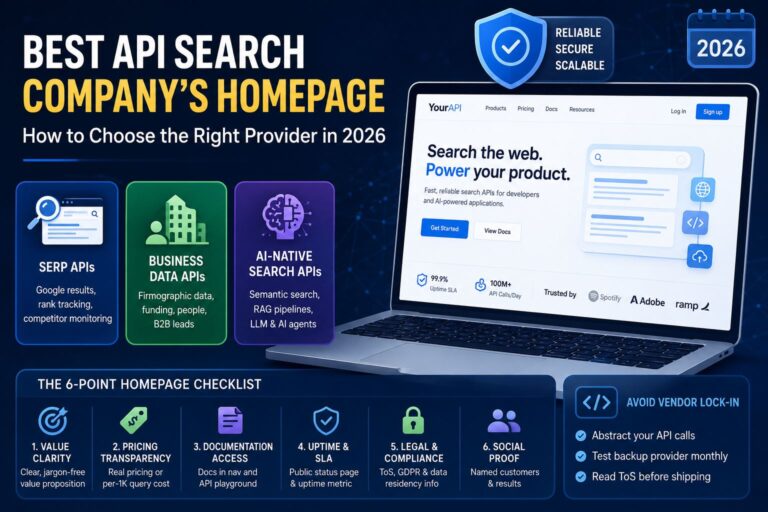
The 3 Types of Search APIs
“Search API” covers three distinct services. Picking the wrong category, however, wastes weeks of integration work. Here is a clear breakdown of each.
Type 1: SERP APIs
SERP APIs query search engines — primarily Google — and return structured results: titles, URLs, and snippets. Providers like SerpAPI and Serper therefore excel at rank tracking and competitive monitoring. Nevertheless, Google had a DMCA case against SerpAPI filed on December 19, 2025. Although SerpAPI still operates and now offers a US legal-protection guarantee, the case adds real platform risk. Consequently, build a swap-out path from day one so you are never fully dependent on a single provider.
Type 2: Business Data APIs
These APIs return firmographic data — company size, funding history, and key personnel — sourced from filings and LinkedIn. As a result, Apollo and Clearbit lead this category for B2B lead generation. Nevertheless, the underlying data typically runs 30 to 90 days stale. Therefore, if you need a company’s live homepage content or current pricing, this category simply will not deliver it.
Type 3: AI-Native Search APIs
It hardly existed three years back but now it is the fastest-growing section.Today, Exa, Tavily, and Firecrawl lead a wave of APIs built for RAG pipelines, LLM agents, and LangChain or LlamaIndex integrations. Instead of ten blue links, these platforms return full semantic context optimized for language models. Additionally, two 2026 updates matter: Nebius announced its acquisition of Tavily in early 2026, and Brave Search API retired its free tier that February — both of which shift the competitive landscape considerably.
The Market Change of 2026
However, in most cases, there have been three factors that have impacted the market between late 2025 and early 2026, all of which are relevant for developers in choosing providers.
The first factor is that the Microsoft Bing Search API ceased operations on August 11, 2025. Unlike a soft deprecation, this was a complete shutdown. The official replacement — Azure AI Foundry’s “Grounding with Bing Search” — requires full platform commitment rather than a simple key swap. Consequently, alternatives like Brave Search API, Exa, and Serper absorbed the displaced traffic, though prices are still settling.
Second, the Google-versus-SerpAPI lawsuit introduced legal uncertainty for any provider scraping and reselling Google results. Moreover, the move made by Brave reduced the available options even more. Finally, the source of the data and platform risks become as important as the feature set.
The 6-Point Homepage Checklist
Before choosing any provider, run its homepage through this six-point test. Two or more missing items signal a serious red flag.
- Value proposition clarity — The hero section explains the API in one jargon-free sentence.
- Pricing transparency — Real numbers, or at least a per-1,000-query estimate, appear without a sales call.
- Documentation access — Docs sit in the main navigation, ideally alongside a live API playground.
- Uptime and SLA indicators — There is a publicly available status page, as well as an uptime percentage metric.
- Legal and compliance information — The terms of service cover GDPR and data residency and are clearly located in the footer.
- Technical social proof — Instead of vague testimonials, we see named customers and measurable results.
Pricing and Best-Fit Comparison (Middle of 2026)
As the prices change very fast in this domain, check the numbers below yourself.
|
Provider |
Type |
Best For |
Free Tier |
Est. $/1K Queries |
|
SerpAPI |
SERP API |
Rank tracking at scale |
100/mo |
~$0.50 |
|
Exa |
AI-Native |
Semantic search, RAG |
1,000/mo |
~$0.25 |
|
Tavily |
AI-Native |
LLM agent results |
Limited |
~$0.30 |
|
Firecrawl |
AI-Native + Scraping |
Full-content extraction |
500 credits |
~$0.20–0.40 |
|
ScrapingBee |
Scraping + Search |
Anti-bot scraping |
1,000 credits |
~$0.40 |
|
Brave Search API |
Independent Index |
Privacy-first search |
None |
~$5/1K |
|
Serper |
SERP API |
Budget Google access |
2,500/trial |
~$0.30 |
For RAG pipelines, Exa and Tavily are purpose-built choices thanks to native LangChain and LlamaIndex support. Meanwhile, Firecrawl wins when your model needs full page content rather than result snippets. SerpAPI, however, continues to be the most evolved SERP solution amid the legal dispute.
Avoiding Vendor Lock-In
Everyone understands that one has to abstract from their dependencies; but not everyone applies this rule to search API before it is too late – as shown by Bing shutdown case, which proved that even an API backed by Microsoft could vanish within six months.
To protect yourself, wrap all search calls behind an internal function from the start, as shown in the code example above.On top of this, remember to verify your backup provider on a monthly basis using canary request to ensure its readiness. First and foremost, always review terms of service prior to implementing something in production – because several providers specifically forbid storing or selling the results obtained from their services.
Conclusion
In essence, the decision-making process begins with the knowledge of what is required: a SERP API that will provide Google results in a structured format, a business data API for firmographic data, or an AI-native search API. From there, every homepage should pass the same six-point test covered above. Moreover, the 2026 shifts — Bing’s retirement, the SerpAPI lawsuit, Tavily’s acquisition — mean platform risk now ranks as a primary evaluation criterion, not a footnote. Therefore, abstract your calls, read the ToS, and keep a backup provider warmed up before you commit.
FAQ
What is the best API search company’s homepage feature to check first?
Above all, check pricing transparency first. A provider that hides costs behind a sales call signals poor developer experience throughout the entire product.
What replaced the Bing Search API after it shut down?
Microsoft’s official path is Azure AI Foundry’s Grounding with Bing Search. However, practical alternatives also include Exa, Serper, Brave Search API, and Firecrawl.
Is using a SERP scraping API legal in the USA?
For personal or research purposes – generally yes, but the resale of results might be prohibited by provider ToS. Moreover, the December 2025 lawsuit of Google versus SerpAPI brings actual legal risks; so always read the terms of service.
What is the difference between a SERP API and an AI native search API?
SERP APIs provide structured data in the form of titles and snippets. By contrast, AI-native APIs such as Exa or Tavily return full semantic content optimized specifically for LLM consumption.
Which search API works best for RAG pipelines and AI agents?
Exa and Tavily are purpose-built for LLM workflows with native LangChain and LlamaIndex support. Meanwhile, Firecrawl is a stronger fit when your model needs full page content rather than snippets.
How do I avoid vendor lock-in when using search APIs?
Just wrap all API calls into your own abstraction layer at the beginning. That way, a provider switch becomes a config change instead of a full refactor. Also, test a backup provider monthly.
What tells me if a search company is legitimate?
It needs to have a public status page, testimonials with actual company names, documentation that does not require logins, and a Terms of Service page. If two or more of these are missing, it indicates a low level of operational maturity.



Pingback: Front End Developer Resume: How to Write One That Gets Interviews - Innodev Solutions