
Introduction
A single untested line of code can take down a banking app, leak customer data, or cost a company millions in a single afternoon. That’s the real reason software testing basics matter to anyone building, managing, or getting curious about software — not because testing looks glamorous, but because skipping testing costs companies a lot.
If you’ve searched for software testing basics before, you’ve probably noticed a pattern: most guides either drown you in academic terminology or are already out of date, missing how testing actually works now that AI agents can plan and run tests on their own.
This guide fixes both problems. You’ll learn what software testing actually is, the core types and levels every tester needs to know, how manual, automated, and the newer agentic testing approaches differ, and how to start building real skills — whether you’re brand new, writing your first tests as a developer, or trying to understand where QA careers are headed.
What Is Software Testing?
Software testing checks whether the software meets its intended purpose before end-users use it. The tester compares the expected results with the actual results and reports any differences.
Quality assurance, or QA, includes testing as part of a broader software quality process. Testing discovers defects; Quality Assurance prevents them through process improvement of the process used in creating the software.
Two words that beginners will often confuse are verification and validation. Verification asks: did we build it correctly, according to the specification? Validation asks: did we build the right thing — the thing users actually need? It is possible for a feature to verify but fail validation if the solution it provides is the wrong one.
Some other standard terminologies that will come your way are:
A Test Case is a particular scenario under test. A Test Plan is a document that describes what needs to be tested and how. A Defect is just another name for a Bug.
Software Testing: Why It Should be Important
What happened in 2012 when a trading firm launched software that still contained test code? The glitch caused millions of unplanned transactions to be done within minutes, resulting in huge losses for the company before it was even possible to stop it. This is an extreme example, but still, it illustrates the problem in a clear way: defects found before the release are cheap, and defects found during production are very expensive.
The sooner the bug is found, the cheaper it will be to fix it. Finding the error while the developer is coding the function may take just minutes, but the same defect found by the client after the product is released can cause many hours of work — up to ten or a hundred times more expensive.
Common mistake: treating testing as a kind of quality check just before the release, and not as part of each development stage.
Types of Software Testing
There are two main types of software testing depending on the problem that needs to be addressed by the test.
Functional and Non-Functional Testing
Functional testing includes the process where it needs to be determined if the application function works fine, that means for instance that when the login button is pressed, the login occurs, the search gives the correct results, and the checkout calculates the amount correctly. Non-functional testing, on the other hand, evaluates how well the software performs in terms of speed, performance under heavy load, and accessibility via assistive devices.
Black Box, White Box and Grey Box Testing
These three terms describe how much a tester can see. Black box testing means the tester only sees inputs and outputs, with no view of the underlying code — ideal for checking a product the way a real user would. White box testing means full access to the code, used to verify internal logic directly. Grey box testing sits in between, useful for integration and security checks where partial system knowledge helps design smarter tests.
| Testing Approach | What It Checks | Typically Used By |
| Black box | Inputs and outputs only | QA testers, end-to-end testing |
| White box | Internal code and logic | Developers, unit testing |
| Grey box | Partial code knowledge | Integration and security testers |
One more trio worth knowing: regression testing re-checks old features after a change, smoke testing is a fast pass/fail check confirming a build isn’t broken, and sanity testing is a quick, narrow check on one specific fix.
Levels of Testing — Unit, Integration, System, Acceptance
Beyond type, testing also happens at different levels, each catching different kinds of problems:
- Unit testing tests one piece of code in isolation – is this single function returning the right value?
- Integration testing tests whether several pieces are working together well – is the login function calling the database correctly?
- System testing tests the entire system from end-to-end under an environment extremely similar to the production environment.
- Acceptance testing verifies that the feature actually meets the original business/user requirements.
Example Here: A login feature gets a unit test asking, “does the password-check function return true for a correct password?” It also gets a system-level test asking, “can a real user actually log in, start to finish, through the full interface?” Both matter, because each one catches a different category of failure the other would miss.
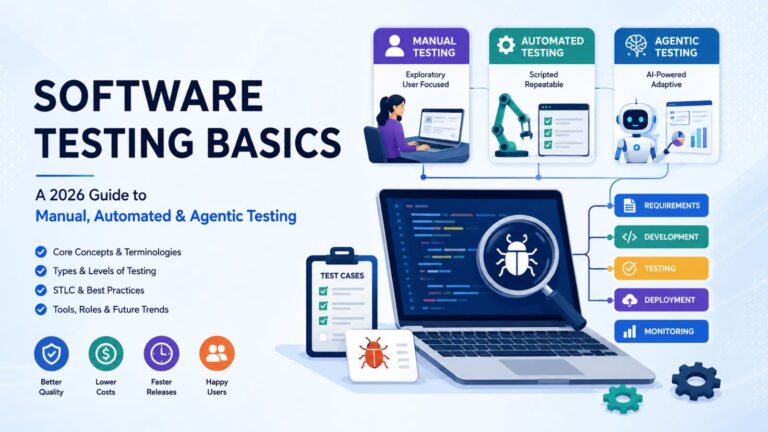
Manual vs. Automated vs. Agentic Testing
Manual testing means a person clicks through the application, trying things a real user would try. It is very flexible and great at capturing any puzzling or counterintuitive experience; however, scaling it up to hundreds of releases is problematic.
Automated testing is when a script performs certain tasks and then verifies that the outcome meets expectations through comparing it to the expected one. It’s fast and consistent, which makes it well suited to regression testing — though someone still has to write and maintain that script.
What Makes Testing “Agentic”?
Agentic testing is the newer layer reshaping the field. Instead of following a fixed script, an AI agent can examine an application, decide what to test, run those tests, analyze the failures, and adjust its approach largely on its own. That’s different from earlier AI-assisted tools, like self-healing tests that automatically fix a broken element selector, or AI-suggested test cases — those still need a human directing the overall process. An agentic system plans and adapts the testing itself.
| Approach | Speed | Best Use Case | Maintenance |
| Manual | Slow | Exploratory testing, usability checks | None |
| Automated | Fast | Regression testing, repeatable checks | Scripts need ongoing updates |
| Agentic | Fast and adaptive | Broad coverage on changing apps | Lower, largely self-adjusting |
If you’re wondering whether agentic testing means human testers are becoming unnecessary, most teams aren’t actually replacing people. They’re shifting what testers spend time on — away from repetitive script-writing and toward strategy, exploratory work, and reviewing what the AI agents produce. Flaky tests, the ones that fail inconsistently for reasons unrelated to a real bug, remain one of the clearest reasons teams still need a human checking results rather than trusting automation blindly.
The Software Testing Process (STLC)
Testing must be done following a consistent process, which is often called the Software Testing Life Cycle (STLC):
- Planning — determine what needs to be tested and why..
- Test design — turn requirements into specific test cases.
- Environment setup — prepare the systems and data needed to run tests.
- Execution and reporting — run the tests and log what passed, failed, and why.
- Closure — review what was learned and what to improve next cycle.
Modern development teams don’t go through this cycle just once prior to release. The process happens in a CI/CD pipeline, meaning that tests will launch every time a developer makes commits, and not only in the final test cycle after all work is done.
Testing Tools, Roles & Starting Up
Once the concepts click, the right tools make practice possible.
Common Tools by Category
| Category | Popular Tools |
| Browser & UI Automation | Selenium, Playwright, Cypress |
| Testing Frameworks | Jest (JavaScript), Pytest (Python) |
| Bug Tracking & Test Management | Jira, TestRail |
Who Does Testing?
Several roles share this work. Manual testers explore the application directly. QA engineers design the overall testing strategy. Developers write their own unit tests as they code. SDETs — Software Development Engineers in Test — are developers who specialize in building the automation frameworks everyone else relies on.
Should you be looking at testing as a profession, the first thing you should look into obtaining would be ISTQB Certification, although this is not mandatory in order to be hired.
Expert recommendation: Your first move shouldn’t be selecting a tool – it should be learning how to do a simple test case for a feature you are using yourself.
Conclusion
Software testing basics come down to one idea: reduce risk by checking that what you built actually works and actually solves the right problem. Start with the fundamentals covered here — definitions, types, levels, and the growing role of agentic testing alongside manual and automated approaches — and you’ll have a real foundation instead of guesswork. Choose some small feature of an application you use frequently, figure out what you will test about it, and you have just started your journey into testing software fundamentals!
FAQ’S
What is software testing in simple terms?
At the simplest level, software testing relies on one principle – making sure that an application works properly before delivering it to its users. The tester assesses the real result and identifies whether it differs from the expected result, and this is called the defect.
How does QA differ from software testing?
Testing means running checks and finding bugs. QA is the more general concept of enhancing processes to ensure no bugs appear. Software testing is only a part of QA, not its alternative.
Is programming knowledge required to become a software tester?
Not necessarily, unless you plan to do automated or SDET jobs. Those types of testing require some programming skills, mostly Python and JavaScript.
What is the difference between automation and agentic testing?
In automated testing, a pre-written script gets executed to test the application. In agentic testing, the process of planning, executing and altering the tests is done by AI agents autonomously.
Is it a safe career with AI taking care of most of the work?
Absolutely. Instead of being replaced, software testing is getting redefined due to AI technologies. Almost all companies employ mixed teams where humans deal with strategic and exploratory work, and AI executes repetitive tasks.
What are the different types of software testing?
There are two major categories, namely functional testing and non-functional testing. Functional testing ensures that the functionality is as expected whereas non-functional testing involves performance, security, and usability testing. Black-box, white-box and gray box refer to visibility during testing.
How much time is required for mastering the basics of software testing?
The majority of novices get familiar with basics in one to two weeks. However, it takes around two to three months for someone to become proficient in manual software testing.