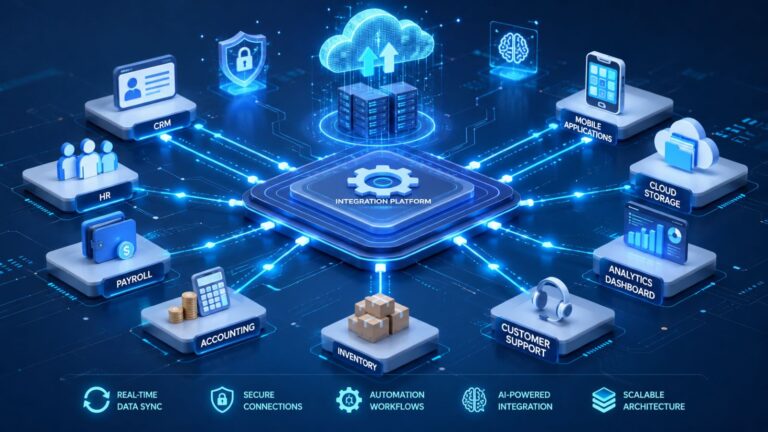

Your CRM doesn’t talk to your accounting software. Data can’t move from your HR system to payroll on its own. So every morning, someone on your team copies numbers off one screen and pastes them into another. That’s the real cost of disconnected software — not a line item on any budget, but hours, accuracy, and money bled away every single day.
Software integration services solve this exact problem. They link your individual applications together so data flows automatically, without anyone re-entering or double-checking it by hand. Dozens of companies fall into the same trap: warehouse staff re-keying orders from a 3PL portal, or an HR coordinator manually entering new-hire data into payroll every other week.
Here’s a full breakdown of what these services include, what they cost, which integration approach fits your business, and how industries from logistics to healthcare put them to work. You’ll also see how AI is reshaping this space in 2026, and where its real limits are.
What Are Software Integration Services?
Software integration services connect two or more applications so they exchange information automatically and run as one coordinated system. A provider evaluates your tools, maps out a connection plan, then builds, tests, and maintains that connection ongoing. In practice, this often means linking Salesforce to NetSuite, or connecting a warehouse system to a shipping carrier’s API so one order update pushes through every downstream system at once.
The term gets confused with two unrelated ones, and search results reflect that confusion.
Clearing Up a Common Mix-Up
“Integrated software” is an older term for a single all-in-one application — think a classic office suite bundling a spreadsheet and a word processor into one program. Microsoft’s SQL Server Integration Services (SSIS) is a specific data tool, not this service category. Software integration services connect separate, independent products; they don’t merge everything into one program.
Why Your Business Needs Software Integration Services
Manual data entry introduces errors that ripple through the rest of the business. An order with the wrong quantity can delay a delivery, and delayed time is lost money. Integration removes that risk: connected systems sync records automatically across every linked application, instead of your team reconciling five conflicting spreadsheets by hand.
Here’s a quick way to tell if you need this now: if staff regularly export a spreadsheet from one system just to re-import it into another, you need software integration services. The same goes for any process where “checking that both systems match” has become a recurring weekly task.
Core Approaches to Software Integration
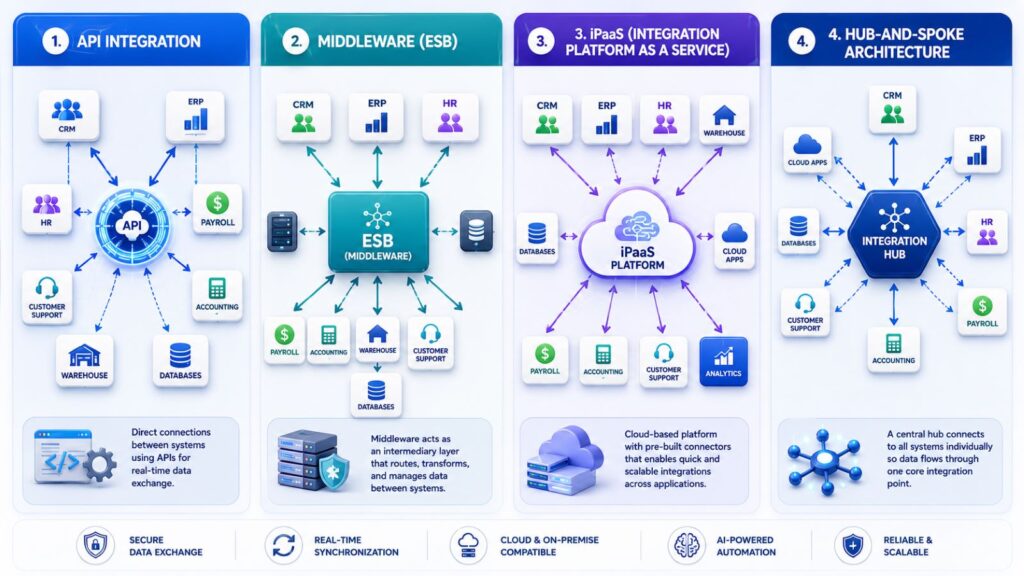
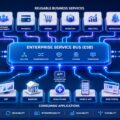
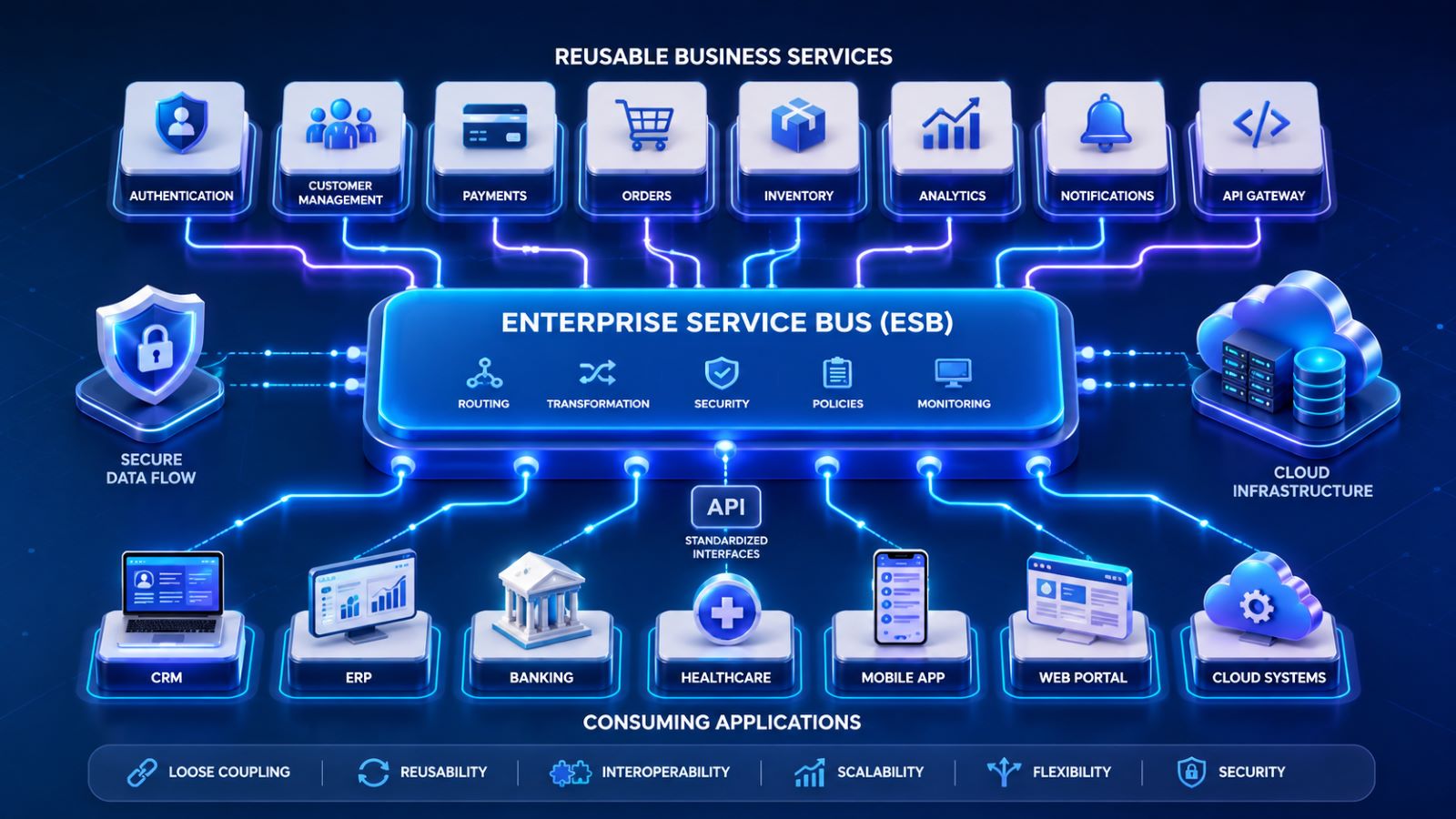
API integration links two systems directly through their APIs and works best for real-time updates, like syncing a new lead into a CRM the moment it’s captured. When an older system can’t connect directly to a newer one, middleware — often an enterprise service bus (ESB) — sits between them and handles the translation.
iPaaS (integration platform as a service) ships with prebuilt connectors for common tools like Salesforce and QuickBooks, making it the fastest route to connect popular applications. Platforms in this space include Workato, Boomi, Make, Zapier, and MuleSoft. Hub-and-spoke architecture takes a different shape: one central hub connects individually to every other application, instead of each app connecting directly to every other app. A webhook — a message sent automatically the moment a relevant event occurs — typically triggers timing across all these approaches.
| Approach | Best For | Typical Timeline |
|---|---|---|
| API Integration | Real-time sync between modern apps | Weeks |
| Middleware/ESB | Complex environments with legacy systems | 1–3 months |
| iPaaS | Fast setup for common SaaS tools | Days to weeks |
| Hub-and-Spoke | Growing companies with many systems | 1–3 months |
Software Integration Services by Industry
In logistics, 3PL software integration services connect your ERP to warehouse management and shipping systems, keeping inventory data synced in real time instead of overnight, and using EDI (Electronic Data Interchange) standards to communicate shipping and order details with outside partners. HR software integration services let a new employee’s data flow through onboarding, benefits, and payroll without anyone logging that information twice or waiting on a paycheck because a system didn’t sync in time.
Healthcare software integration services connect EHR systems to billing and scheduling platforms under HIPAA, using data exchange standards like HL7 or FHIR. Field service and financial services each carry their own integration requirements worth understanding on their own terms.
How Do You Connect Field Service Software to a CRM?
The most direct route is an API or iPaaS connector that feeds scheduling, dispatch, and job-completion data from your field service management (FSM) software into the CRM. That gives sales reps real-time visibility into technician status without touching either system’s core workflow.
AI Integration Services: The 2026 Shift
Integration used to mean custom code written for every single connection. Today, AI-driven integration services speed that process up by generating data mappings automatically and catching formatting errors before they break a workflow downstream. Manual builds are giving way to automated workflows, and increasingly to agentic systems that monitor and repair connections on their own.
Integrating an AI Chatbot with Existing Customer Service Software
Most modern helpdesk platforms ship with built-in AI connectors. That makes the process fairly predictable: connect the chatbot to your ticketing platform’s API. Match conversation data to customer records. Define clear rules for when a human agent steps in. Test the handoff thoroughly before going live. Even fully agentic systems still need human oversight — especially around data privacy and approval steps for sensitive changes in regulated industries like healthcare and finance.
How to Select the Best Software Integration Partner
An iPaaS subscription might be all a small team needs to connect two SaaS tools. An enterprise with legacy systems usually needs a dedicated integration services provider. Look for custom development capabilities and verifiable references in their industry. Watch for red flags: vague or opaque pricing, no clear testing process, and a portfolio with no examples that resemble your own tech stack.
Comparing platforms before you integrate them saves rework down the line, and a short checklist makes that easier.
How to Compare Customer Service Software for Easy Integration
Look for prebuilt connectors for the tools already in your stack, open API access with thorough documentation, and a track record supporting the specific CRM or helpdesk platform you use. Ask for a reference client running a similar tech stack — not just a generic case study. A strong provider walks you through every stage: discovery, design, build, testing, and post-launch support with a named contact for issues that come up later.
Conclusion
Disconnected software drains a company’s time, accuracy, and room to grow. Software integration services turn a scattered set of tools — CRM, ERP, HR, and industry-specific platforms — into one functional system. Whether you’re linking a 3PL platform to your supply chain software, connecting payroll to staffing software, or adding a chatbot to support, the right integration strategy depends on what you’re actually solving for. Start by auditing your processes to find where manual work is creeping in, then pick the approach that matches.
What is software integration services?
It's the professional connection of two or more software applications so they share data automatically, eliminating manual entry between disconnected systems.
How do I integrate field service software with my CRM?
Most providers use API connections or an iPaaS platform to sync scheduling, dispatch, and customer records between the two systems in real time.
How to integrate AI chatbot with existing customer service software?
Connect the chatbot to your ticketing system's API, map conversations to customer records, set escalation rules, and test the handoff before launch.
How to integrate payroll services with staffing software?
Connect your staffing platform's employee records to payroll through an API or middleware layer so hours and pay data sync automatically each cycle.
Which integration service is best for syncing business software?
iPaaS works best for common SaaS tools; custom API or middleware suits complex, legacy, or highly specific business systems.
What are enterprise software integration services?
Large-scale integration projects connecting multiple core business systems, such as ERP, CRM, and HR platforms, across departments and legacy infrastructure.