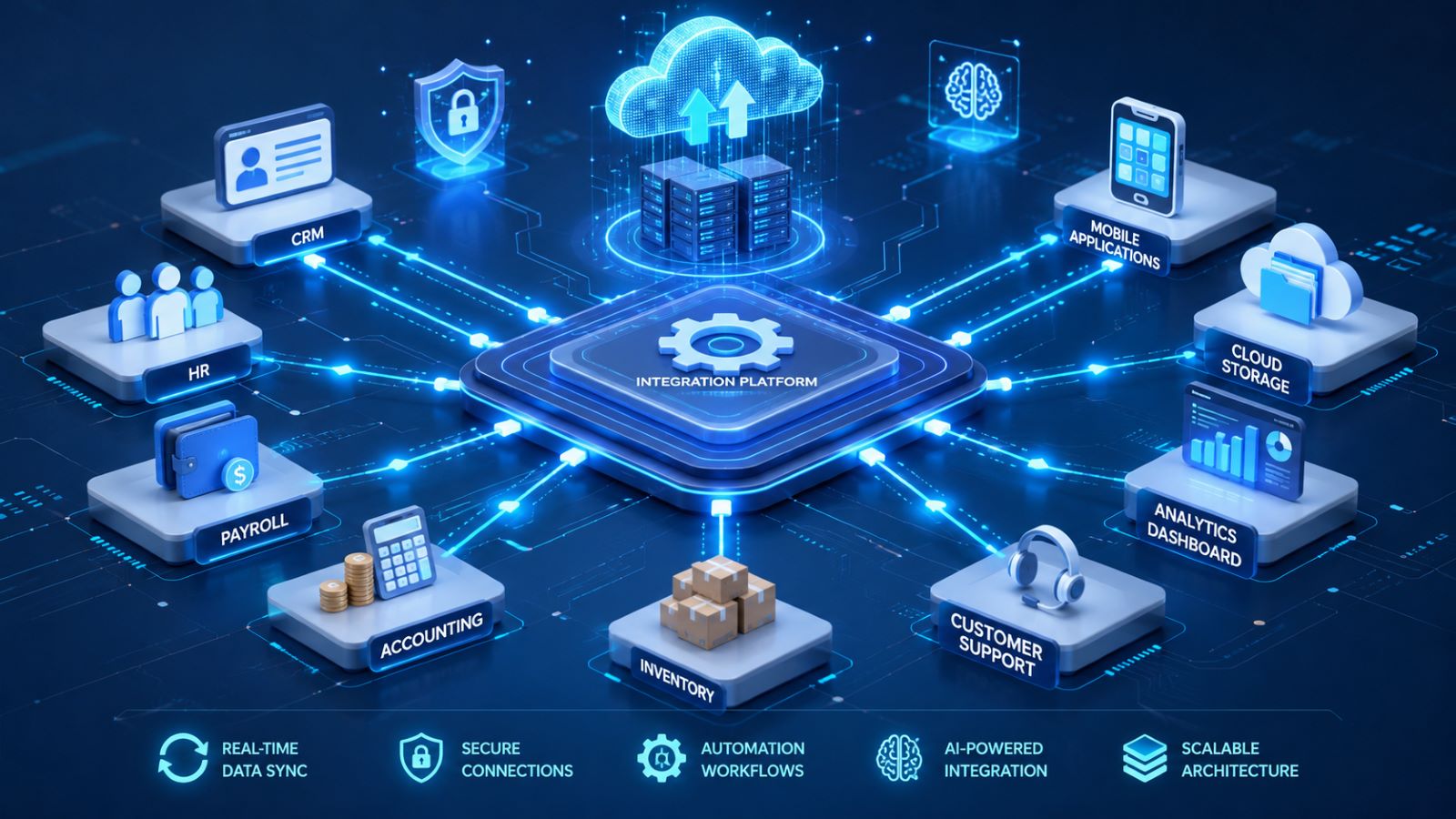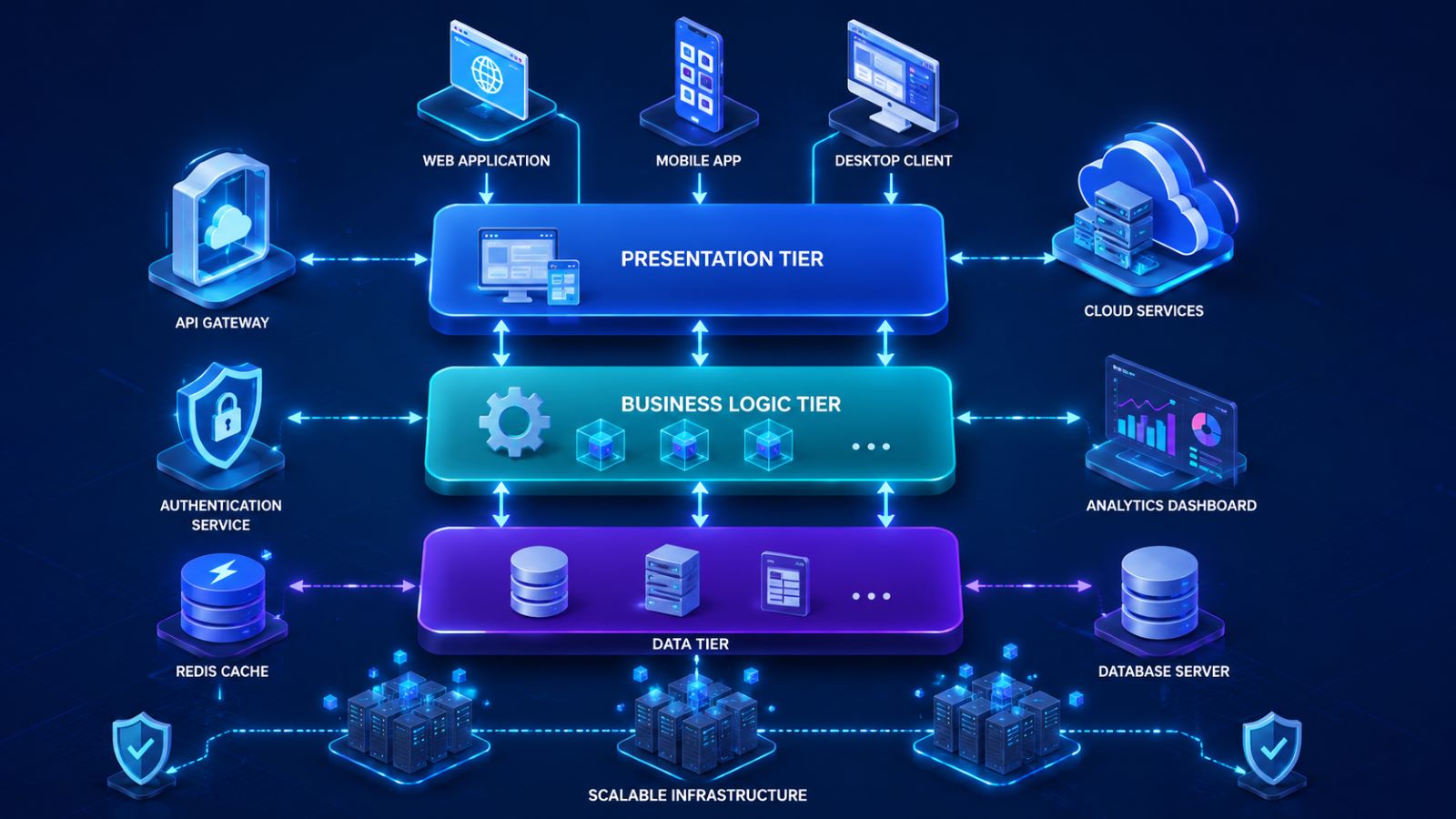
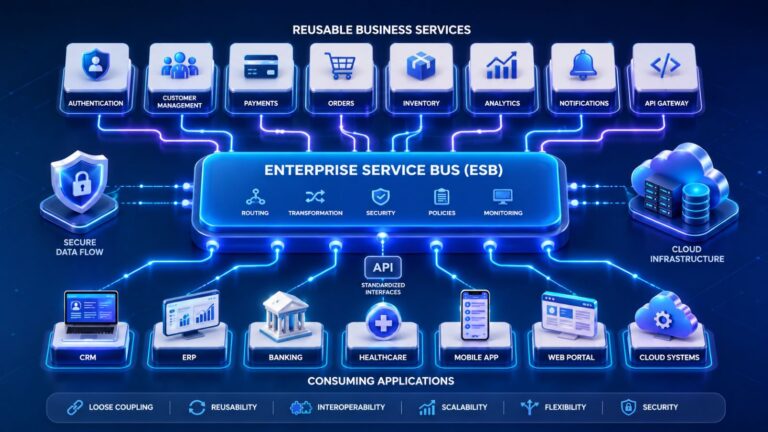

When most developers hear “SOA” they think microservices, but older. That blunder costs interviews, design reviews and modernization budgets. Today, service-oriented architecture builds software from independent, reusable services — and it powers critical systems in banking, healthcare, telecom, and government. This guide explains what SOA means, how it works, where you’ll find it in real systems, and how it relates to microservices and event-driven architecture. You’ll also get a straight answer to the question everyone searches but rarely finds answered: is SOA dead?
What Is Service-Oriented Architecture (SOA)?
SOA exposes a business’s capabilities as services that other applications can reach over the network and reuse — through a standard service contract, not hard-coded direct integration.
Imagine the public services of a city. Think of a city’s utilities. Water, electricity, and internet run independently, but every building connects to them the same standard way. SOA works the same way: independent services communicate through a common interface style instead of one-off connections.
This is not just breaking up code into lots of small files. Each service in SOA oriented architecture must be discoverable, reusable and must have a formal contract. A single authentication service consumed by five internal applications is SOA, but five applications with no relationship to each other calling each other directly is not.
How Does Service-Oriented Architecture Work?
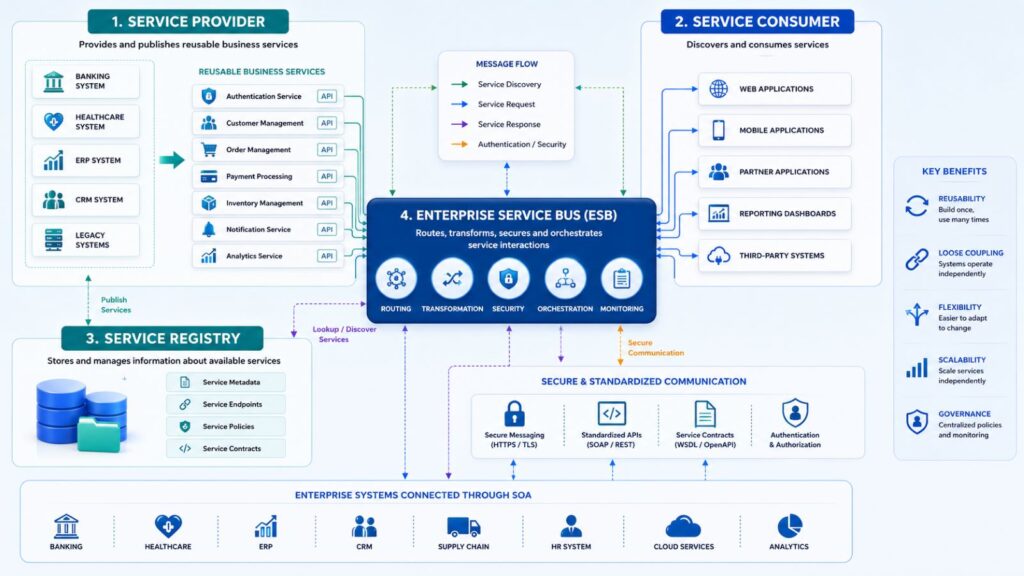
Each SOA deployment is based on four elements, the service, a service provider that keeps it, a service consumer who invokes it, and a service registry that advertises services that are available for discovery. These pieces follow the principles of loose coupling, abstraction, and composability — often enforced through an enterprise service bus (ESB).
Here is where the ESB fits into daily operations.
Enterprise Service Bus, Explained Simply
Communication is typically over classic SOA way (SOAP, WSDL) or a newer one (REST, gRPC). The ESB handles these messages, converts data formats and links services without them needing to know about each other. It’s also very strong but very much a single point of failure if it fails, as everything relies on it.
Service-Oriented Architecture Examples Worth Knowing
Enterprises typically use SOA to give multiple business lines — mortgage, auto loan, credit card processing — access to a shared credit-check service instead of reimplementing that logic each time. Healthcare institutions do the same, by leveraging a single patient registration service to power call centre, physician portals and self-service.
A less obvious, current example: modern vehicles increasingly use automotive service-oriented architecture, where navigation, diagnostics, and infotainment systems communicate through standardized service interfaces instead of tangled point-to-point wiring. But what brings every real example together is reuse — if taking one thing out means you need to rebuild three others, it ain’t really SOA.
Service-Oriented Architecture Security
Each service exchange must have its own set of authentication and authorization checks, and a consumer should not be trusted simply because it is located in the same network. The ESB is a worthy of special mention as it carries almost all traffic and if compromised becomes the greatest target.
Follow these practices when securing an SOA deployment:
Authenticate every service call individually rather than trusting network location. Encrypt messages in transit, and at the message level for sensitive data. Version service contracts carefully so changes do not silently break consumers. Monitor the ESB continuously, since its failure affects every connected service.
SOA vs. Microservices vs. Event-Driven Architecture
SOA is an enterprise level solution that links entire applications together. A microservices paradigm breaks up an application into independently deployable pieces at the application level. Event-driven architecture is based on the concept that components respond to events, not on their centralization.
SOA normally works with synch, ESB-routed requests. Microservices tend to prefer either living as lightweight, zero-client helper/vulnerability calls via Docker and Kubernetes. Event-driven systems decouple components entirely — events get published and consumed asynchronously through a message broker like Kafka or RabbitMQ. Choose SOA if you rely heavily on monolithic or legacy systems, choose microservices if you’re a fast-moving cloud-native team, and choose event-driven architecture when your components need real-time responsiveness.
Is Service-Oriented Architecture Dead?
No, but it’s been reduced. New cloud-native projects do not start from SOA but rather microservices or event-driven patterns. It’s the unstoppable powers of SOA that keep it alive in banking, telecom and government infrastructure: It’s the ability to bring sprawling legacy systems together in one governance model.
This question is often asked, so here’s the direct answer to a similar question.
Will SOA and Microservices Coexist?
Yes. Many companies maintain their core systems on SOA and gradually are developing new features as microservices, which they then integrate with the core systems via a gateway API.
Service-Oriented Architecture in Cloud Computing
Cloud computing is not an enemy of SOA’s concepts, it just renamed them. The ESB’s new role is being taken by an AWS, Microsoft Azure, or Google Cloud API gateway. A service catalog is similar to the service registry that existed in the past, enabling teams to find services that already exist before creating new ones in the cloud.
The same reasoning is cropping up in an unanticipated place.
SOA Principles Behind AI Agents
AI agents that call external tools are based on a similar concept to that of SOA, which was the introduction of a discoverable interface that abstracts implementation details. In this way, service contracts are the modern reincarnation of agent orchestration frameworks for AI systems, rejuvenating the value of SOA literacy.
Benefits, Limitations, and Common Mistakes
The core benefits are real – it speeds development by reusing code, reduces maintenance pain and provides a way to modernize legacy applications without wholesale rewrite. The constraints are just as substantial: Governance overhead can easily escalate, and that never-gone-ESB-single-point-of-failure syndrome remains much the same. The biggest error is to view SOA as a technology to buy, rather than a discipline, and to purchase an ESB, and expect governance to take care of itself.
Conclusion
SOA is not a relic, it is not a buzzword; it’s a definite solution to how to connect large, complex systems using reusable, governed services. It is not a microservice and it’s not a message-driven application, and it’s still a good option for those businesses that rely heavily on legacy systems. The key principles of security and governance are a crucial determinant of real deployments and are being reiterated in the way organizations are integrating AI agents today. Help comes from understanding SOA—and not the “old microservices”—on its own terms.
What is service-oriented architecture in simple terms?
It's a way of building software from independent, reusable services that communicate through standardized interfaces, similar to how city utilities work.
Is service-oriented architecture the same as microservices?
No. SOA connects whole applications enterprise-wide, while microservices break a single application into small, independently deployed pieces.
Is service-oriented architecture dead?
Not dead, but narrowed. New cloud-native projects favor microservices, while SOA still runs legacy enterprise, telecom, and government systems.
What are the four main components of SOA?
Service, service provider, service consumer, and service registry, connected through standardized service contracts.
Is SAP a service-oriented architecture?
SAP implementations often use SOA-style patterns, but SAP itself is a vendor platform, not an architectural style.
Can SOA and microservices coexist?
Yes. Many organizations keep legacy systems on SOA while building new features as microservices, linked through an API gateway.