
Most applications begin with an easy-to-use approach. Then you add another feature, another database, another mobile client — and suddenly, changing one thing in the codebase without breaking everything else feels like a nightmare. N-tier architecture exists to fix exactly that. It divides an application into distinct components and a change in one component does not affect the other. This guide will demystify what n-tier architecture is, clarify the difference between tier and layer, and provide some examples of real implementations, and discuss if it is still relevant in a project for 2026.
What Is N-Tier Architecture?
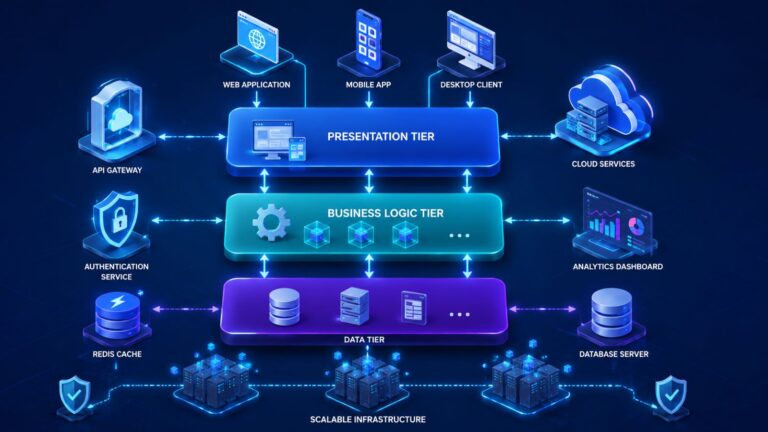
In software engineering, N-tier architecture is a design pattern that divides an application into distinct layers, usually there are three layers: presentation, business logic, and data. The “n” is because the number of tiers is not fixed at three, and may be more depending on the complexity of the system. This is a concise definition of the word that comes with the majority of searches for this term, and the remainder of this guide delves into each piece.
N-tier architecture is the separation of an application into distinct tiers, typically into a presentation tier, a business logic tier, and a data tier. Each part does one task, can be built, tested and scaled independently. Suppose a company uses a logistics system, with the presentation tier displaying a live map to drivers, the business logic tier computing routes, and the data tier holding information on shipments. Later, a customer-facing mobile app will be added, only the presentation tier changes.
Tier vs. Layer: The Distinction Most Guides Skip
A layer is an abstraction of code, consolidated together according to their function, e.g. the validation rules or the entities in the database. A tier is a physical deployment unit, is a server or a process. Three logical layers can be implemented on one machine, or three physical tiers (with the same three layers of logic) can be implemented across a network. The common mistake of developers with these two words is the use of them when discussing the pattern.
How N-Tier Architecture Got Here? (1-Tier to N-Tier)
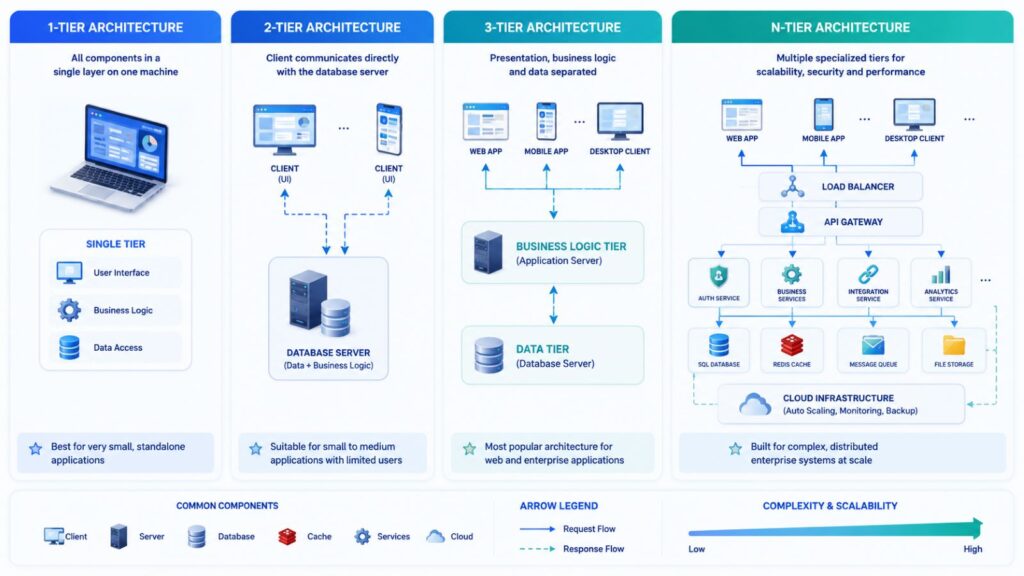
In a small desktop app, everything is provided by a 1-tier system, even the interface, logic and data; all on one machine. The 2-tier (client-server) approach is a separation between the user interface and data source. This 3-tier architecture has a separate business logic layer between these two, and is the most popular configuration in the field today. If there is an additional layer of separation (such as an integration layer or caching layer), then the system is truly n-tier since there is no longer any limit to the number of tiers in the system.
What makes up the core tiers in an N-Tier Application?
The typical n-tier application (C#, Java or other stack) has three major components that work in tandem. The presentation layer is the layer users see, typically built with React or Angular. The business logic tier houses the application’s rules, like credit checks and permissions. The data tier stores data (usually in SQL server or other NoSQL store, like MongoDB, but not directly with the presentation tier).
Sometimes there are additional tiers added onto larger systems. There can be a service tier to handle third party API integration, and a caching tier with Redis to minimize the loading of the database repeatedly. The additional levels should address a real problem, not just for the sake of complexity.
What are the pros and cons of n tier architecture in this case?
Maintainability is the greatest advantage of this pattern. Splitting responsibilities lets a team change the data tier without touching presentation code. It also scales independently — add servers to the busiest tier only — and strengthens security, since sensitive data gets its own protections, which matters for compliance policies like HIPAA or PCI DSS.
The tradeoffs are real too. Every extra tier adds network latency and infrastructure cost, and testing becomes harder across multiple tiers. Managed cloud services now absorb much of that traditional cost, which was far less true a decade ago.
Below is a quick reference comparing the core tradeoffs.
| Factor | Advantage | Disadvantage |
|---|---|---|
| Maintainability | Update one tier independently | More moving parts to coordinate |
| Scalability | Scale only the busiest tier | More infrastructure to monitor |
| Security | Isolate sensitive data | Larger overall attack surface |
| Performance | Clear separation of duties | Added latency between tiers |
N-Tier, Microservices, or Clean Architecture – which to choose?
The concept with microservices is to decompose an application into numerous small, independent deploy-able services, each of which has a specific business capability, at the expense of adding additional operational overhead. While the clean architecture by Robert C. Martin’s approach draws on n-tier but enforces it more strictly. Choose between them based on team size and project complexity — you can start with n-tier and move individual tiers to independent scaling or deployment only when they actually need it.
How Do You Implement N-Tier Architecture in C#, Java, and ASP.NET MVC?
A typical C# n-tier project splits into three class libraries: one for presentation, one for business logic, one for data access. In ASP.NET MVC, controllers are thin, they call business services, which then call repository class to interact with the database and there is no validation code in the UI.
Java n-tier applications follow the same structure, typically using Spring MVC for the presentation tier and a Hibernate-backed repository for the data tier. One of the most popular “tricks” to avoid: the presentation layer directly accesses the database “just this one time” and that effectively circumvents the whole point of the pattern.
What is the working of N-Tier Architecture on AWS and Azure?
On AWS, the business tier typically runs in auto-scaling groups behind an ELB, the data tier runs on managed RDS, and the presentation tier runs on EC2 or ECS. Azure’s alternative solution is to deploy App Service or virtual machine scale sets, an Azure Load Balancer, Azure SQL Database, and it’s analogous to the advice that Microsoft has made public in the Azure Architecture Center. It is also possible to separate each tier into a different subnet on both platforms, to limit the data tier’s ability to access resources from the business tier, and many teams are deploying each tier on its own container (Docker and Kubernetes) for more predictable scaling.
Should N-Tier Architecture be Used in 2026?
Yes, in many, many true projects. It’s still the best choice for teams who already know the pattern, when compliance demands data separation, or when it’s necessary to have a clear direction for moving from an on-premises infrastructure to the cloud. The added complexity is inherently the case when an application requires various components to scale and deploy separately.
AI coding assistants now generate this boilerplate for each tier automatically, so developers review the structure instead of typing every line. Do the size, deployment target and scale of your team really require a full microservices-based system, or will a well constructed n-tier system be equally effective, but with substantially less overhead.
Conclusion
N-tier architecture remains very useful architecture as the application grows. It separates the systems into presentation, business logic and data components to ensure maintainability, security and scalability in the long run. It creates some practical problems like latency and infrastructure cost, but with the recent introduction of modern cloud services and containers, these are now much more manageable than ever before. Regardless of the technology used, such as C# or Java and whether building on AWS or Azure, knowing this pattern will provide you with a reliable building block for actual projects in 2026.
What is n-tier architecture in simple terms?
It separates an application into independent parts, usually presentation, business logic, and data, so each part can be built and scaled on its own.
What will be the difference between 3-tier and n-tier architecture?
3-tier is the use of exactly three layers. Any number of tiers, including four or more, is known as n-tier.
What is the difference between tier and layer?
A layer is a logical grouping of code according to its responsibility. A tier is a unit of physical deployment running on a server.
Does n-tier architecture equal microservices?
The difference is that No. N-tier divides up functions within a single system, but microservices divide up an application into independent, business-oriented services.
Is n-tier architecture outdated in 2026?
No. It still fits many enterprise and cloud-migration projects, especially where team familiarity and compliance needs matter most.
What are the main disadvantages of n-tier architecture?
Added latency between tiers, higher infrastructure costs, and harder testing across tier boundaries, though managed cloud services reduce these costs today.